
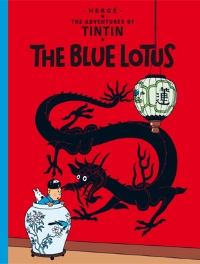
The Blue Lotus
In the sequel to Cigars of the Pharaoh, Tintin is in India taking a well-earned rest when he is drawn into a dangerous mystery revolving around a madness-inducing poison known as opium. Our tenacious young reporter travels to Shanghai—the source of the international opium trade—where it begins to look as though Tintin has bitten off more than he can chew.
With the assistance of the secret society Sons of the Dragon, and his new friend Chang, Tintin succeeds in overcoming myriad obstacles to finally triumph over his adversaries and disband their network of corruption. Set within the real historical context of the tensions between China and Japan during the 1930s, The Blue Lotus marked the first time the Chinese culture was represented in cartoon art in what could be considered a realistic way. Hergé relied on the assistance and insight of Chinese artist Chang Chong-chen, who was immortalised by a character of the same name in the story and who became Hergé's lifelong friend.
About the Adventures of Tintin Series
Books in series order
- 1.Tintin in the Land of the Soviets(1929)
- 2.Tintin in the Congo(1930)
- 3.Tintin in America(1932)
- 4.Cigars of the Pharaoh(1934)
- 5.The Blue Lotus(1935)
- 6.The Broken Ear(1937)
- 7.The Black Island(1937)
- 8.King Ottokar's Sceptre(1939)
- 9.The Crab with the Golden Claws(1941)
- 10.The Shooting Star(1942)
- 11.The Secret of the Unicorn(1943)
- 12.Red Rackham's Treasure(1945)
- 13.The Seven Crystal Balls(1948)
- 14.Prisoners of the Sun(1949)
- 15.Land of Black Gold(1950)
- 16.Destination Moon(1953)
- 17.Explorers of the Moon(1954)
- 18.The Calculus Affair(1956)
- 19.The Red Sea Sharks(1958)
- 20.Tintin in Tibet(1960)
- 21.The Castafiore Emerald(1963)
- 22.Flight 714(1968)
- 23.Tintin and the Picaros(1976)
- 24.Tintin and Alph-Art(1986)
Reading age: 8+ years
Clever and ever-curious, Tintin is a reporter-turned-detective whose pursuit of villains, criminals, treasure and the occasional hostorical artefact takes him all over the world. Join Tintin and a colorful cast of friends, including his faithful dog Snowy, Captain Haddock, absent-minded Professor Calculus and the Twins, as they embark on an extraordinary adventures spanning historical and political events, fantasy and science-fiction adventures and thrilling mysteries. These full-color graphic novels broke new ground when they were first released and became the inspiration for countless modern-day comic artists. . Belgian-artist Hergé based his stories on real-world events and cultures that had caught the Belgian national attention—from space exploration to Arab oil wars—and brought them to life for his readers in inspiring and exciting ways.
The series was one of the most popular European comics of the 20th century, and it remains popular today. By the time of the centenary of Hergé's birth in 2007, Tintin had been published in more than 70 languages with sales of more than 200 million copies worldwide.